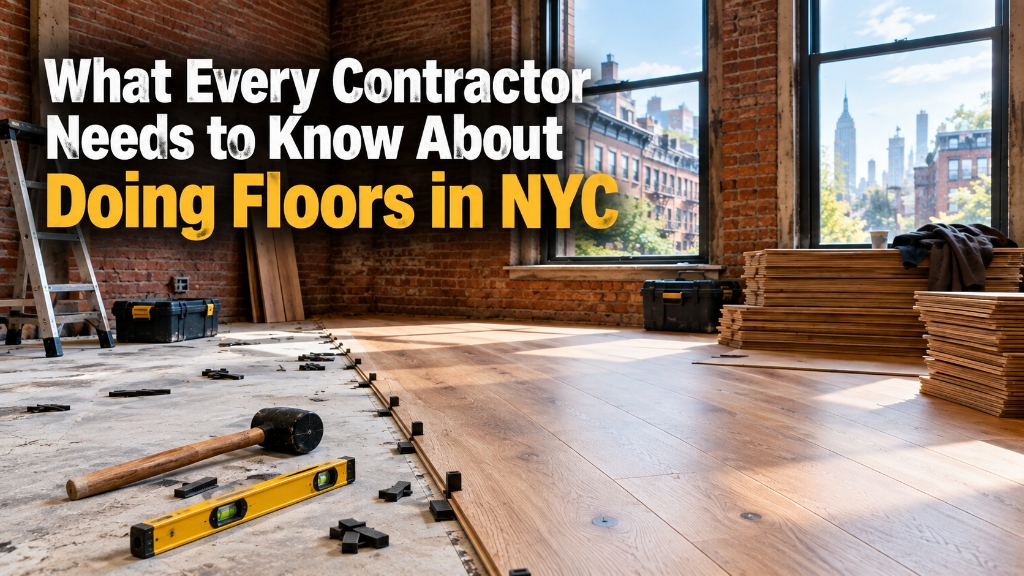
If you have ever tried hauling three pallets of European white oak down a one-way street in Brooklyn at 7:00 AM while a traffic agent hovers over your bumper, you already know: putting down floors in New York City is a completely different ballgame. Between tight freight elevator windows, century-old unlevel subfloors, strict co-op acoustic rules, and boutique retail showrooms overcharging for basic stock, a job can eat through your profit margins before the first box is even opened.
Whether you are remodeling a landmark brownstone in Park Slope, outfitting a high-rise rental in Long Island City, or bidding on a commercial fit-out in Midtown, this guide breaks down what actually works on the job site—which materials survive local climate swings, how to avoid acoustic sign-off rejections, and how partnering with a genuine wholesale trade supplier keeps your schedule intact.
1. Welcome to New York: Tight Elevators, Century-Old Subfloors, and Building Supers
Doing flooring anywhere else in the country is straightforward compared to the five boroughs. You cannot simply back a 53-foot flatbed into a driveway, unload at your leisure, and stack boxes in a double garage. In NYC, logistics make or break the job:
- Restricted Elevator Windows: Most luxury residential and commercial towers grant contractors a strict 45-to-60 minute freight elevator booking. If your material delivery is delayed by cross-borough traffic, your slot vanishes, your crew sits idle on billable hours, and the super reschedules you for next week.
- Pre-War Structural Quirks: Historic brownstones in Brooklyn and Harlem feature 100-to-140-year-old pine subfloors with noticeable dips, crowning, and bounce. Forcing a rigid floor over these joists without proper structural prep guarantees squeaks, hollow thumps, and homeowner callbacks.
- Modern Concrete Slabs: High-rise concrete decks in Queens, Brooklyn, and Manhattan frequently emit latent moisture vapors. Unless you run moisture mitigation and testing, adhesives will break down into liquid slurry within months.
Having a reliable local wholesale partner with regional yard warehousing—capable of scheduled box-truck deliveries directly when your crew is ready—eliminates curbside panic and parking tickets.
2. Engineered Wood vs. Solid Timber: Why Real Wood Can Break Your Heart Here
Every homeowner loves the romance of traditional solid timber. But installing solid 3/4-inch wood planks in a typical New York apartment or radiator-heated townhome is asking for trouble.
The reason comes down to radical humidity shifts: in winter, steam radiators and central forced-air heat drive indoor relative humidity down to bone-dry levels under 25%. In July and August, East Coast humidity easily surges past 75%. Solid hardwood drinks up that seasonal moisture, swells, and cups at the edges—only to shrink into wide, unsightly floor gaps once the heating pipes start clanking in November.
This is why engineered European white oak has become the uncontested standard for NYC contractors:
- Unmatched Dimensional Stability: Engineered timber features a multi-ply cross-grained birch or eucalyptus core under a solid wood veneer. This cross-ply lattice structure reduces seasonal expansion and contraction by more than 70%.
- Zero Need for Sleeper Subfloors: Solid hardwood cannot be glued directly to concrete slabs without adding double-plywood or wood sleeper framing, sacrificing 1.5 to 2 inches of precious ceiling height. Engineered flooring can be glued down directly over prepped concrete slabs with acoustic moisture-barrier adhesives.
- The 4mm+ Wear Layer Rule: Always specify an engineered product with a 4mm to 6mm sawn wear layer. This gives your clients the exact same sand-and-refinish lifespan (up to 3 to 4 times) as solid wood without any of the warping hazards.
3. Luxury Vinyl (LVT/SPC): When to Glue It Down vs. When to Click It In
Modern commercial vinyl has completely evolved past the cheap laminate and peel-and-stick tiles of the past. With high-definition embossed-in-register (EIR) wood-grain textures, clients often cannot tell it apart from real timber until they kneel down and touch it. However, selecting the right installation system is crucial for durability:
Glue-Down LVT (The Commercial Benchmark)
If you are working on multi-family building corridors, rental portfolios, commercial doctor suites, or retail storefronts, glue-down luxury vinyl is the undisputed champion. It has zero vertical plank flex under heavy rolling carts, wheelchairs, and delivery dollies. Even better: if a tenant gouges a plank while dragging heavy furniture, your maintenance guy does not need to pull off baseboards across the whole room. Just warm the damaged plank with a heat gun, peel it up, roll down fresh pressure-sensitive adhesive, and drop in a fresh plank in five minutes.
Click-Lock SPC (The Fast-Turnaround Hero)
Stone Plastic Composite (SPC) features an ultra-dense limestone core that is 100% waterproof and rigid. For brownstone garden-level apartments, basement suites, or fast renovation turnovers on tight deadlines, click-lock SPC snaps together quickly with pre-attached acoustic pads, cutting installation labor times by up to 35%.
Contractor Spec Tip: Never install anything under a 20-mil commercial wear layer for multi-family rentals or commercial projects. A 12-mil residential plank may save a few cents per square foot initially, but high traffic, boots, and pet claws will dull the finish in under two years.
4. Don’t Get Shut Down by the Board: Mastering Soundproofing & Acoustic Codes
Nothing stops a renovation in its tracks faster than an angry downstairs neighbor complaining to the managing agent that they can hear every footstep upstairs.
While the NYC building code specifies minimum sound ratings of IIC 50 (Impact Insulation Class) and STC 50 (Sound Transmission Class), premier co-op and condo boards routinely mandate certified field testing of IIC 60, 65, or even 70 before alteration approval is granted.
- Choose Tested Underlayment Systems: Cheap foam rolls will fail co-op board audits. Stick to high-density recycled acoustic rubber membranes (2mm to 5mm) or certified 100% natural cork (6mm).
- Use All-in-One Sound-Damping Adhesives: When gluing engineered hardwood, invest in premium silane or elastomeric urethane adhesives that integrate moisture mitigation and acoustic sound deadening into a single troweled pass. It cuts labor steps in half while keeping the board happy.
- Always Present Lab Cut-Sheets Early: Ask your wholesale flooring supplier for the manufacturer’s certified ASTM acoustic test report matching your building’s exact ceiling/slab assembly. Submitting this with your alteration package prevents weeks of back-and-forth approval delays.
5. Subfloor Prep: Why Rushing the Base Costs Double Later
Over 80% of all flooring failures—from hollow sounding spots and cracked click-locks to adhesive debonding—have nothing to do with product defects. They happen because installers rushed the subfloor prep.
- Flattening the Dips: Industry standards require subfloor flatness within 3/16 inch across a 10-foot radius (or 1/8 inch over 6 feet). If you lay click-lock SPC or engineered planks over low spots, the floor will flex vertically, stressing the locking tongue until it snaps. Sand down high humps and pour commercial self-leveling underlayment (SLU) with an acrylic primer over low pockets.
- Testing for Concrete Moisture: Concrete can look bone dry to the naked eye while pumping gallons of vapor pressure upward. Always perform an in-situ relative humidity (RH) probe test or calcium chloride moisture test. If RH readings exceed 80%, roll down an epoxy or polymer moisture-vapor barrier before applying floor adhesive.
6. Sourcing Like a Pro: Stop Paying Retail Markups at Big-Box Showrooms
If your business is buying materials off the shelf at retail home improvement warehouses or boutique Manhattan tile showrooms, you are essentially forfeiting your project profit margins.
Boutique retail outlets mark up materials by 40% to 70% to pay for high-rent street-front showrooms. Worse yet, when you run three boxes short near the end of a phased multi-unit project, they often inform you that the dye lot is sold out and replacement boxes are on an eight-week backorder from Europe or California.
Working directly with a dedicated wholesale trade flooring supplier delivers three crucial advantages:
- True Contractor Trade Pricing: Protect your bid margins with tiered volume discounts on commercial-grade European oak, LVT, carpet tile, and rubber gym flooring.
- Guaranteed Dye-Lot Consistency: For multi-story residential builds, a wholesale supplier reserves your complete footage from the exact same factory production run, ensuring Unit 1 and Unit 20 feature perfectly matched color and grain patterns.
- Single-Invoice Accessory Bundling: Pick up matching flush stair nosings, T-moldings, reducers, sound underlayment, and moisture adhesives on a single trade order. Everything matches, fits, and carries unified warranty backing.
7. Clean Air and Low Smell: Keeping Building Neighbors Happy
In tightly sealed apartment buildings where shared hallway ventilation is limited, chemical smells travel fast. Strong solvent odors inevitably lead to tenant complaints to building management, which can get your job shut down by midday.
- Stick to Low-VOC, Solvent-Free Adhesives: Modern advanced polymer and water-based adhesives cure rapidly, hold with incredible shear strength, and produce almost zero detectable odor during and after application.
- Demand Certified Indoor Air Quality: Always verify that materials carry recognized green certifications such as FloorScore® or GREENGUARD Gold. When design clients or building inspectors ask for confirmation that products meet safe indoor air quality thresholds, having these certificates ready prevents disputes.
The Bottom Line: Winning More Bids with the Right Trade Partner
Executing profitable, callback-free flooring installations across New York City comes down to a few core fundamentals:
- Specify engineered white oak with a 4mm+ wear layer to handle concrete slabs and steam radiator climate swings.
- Deploy 20-mil glue-down luxury vinyl for commercial spaces, corridors, and heavy-wear rental properties.
- Always verify subfloor flatness and moisture levels before the first board is installed.
- Secure tested acoustic cut-sheets to breeze through condo and co-op board approvals.
- Source directly through a wholesale trade specialist like Woodcraft Flooring NY to secure trade discounts, batch consistency, and reliable local delivery.
Ready to Source Wholesale Flooring for Your Next NYC Project?
Woodcraft Flooring NY supplies general contractors, developers, and trade professionals with top-grade engineered hardwood, commercial LVT, carpet tile, and rubber flooring at direct wholesale pricing.
Frequently Asked Questions (Trade FAQs)
1. Can I glue engineered hardwood directly to concrete in a high-rise?
Yes, as long as the slab is thoroughly cured, flat (within 3/16″ over 10 feet), and tested for moisture emissions. Always use an elastomeric urethane or silane-polymer adhesive that includes an integrated moisture barrier and acoustic rating.
2. What wear layer thickness is best for residential rental apartments?
For luxury rentals using engineered wood, a 3mm to 4mm wear layer provides solid longevity. For vinyl plank or tile (LVT), always specify a minimum 20-mil commercial wear layer to withstand frequent tenant turnover, pet claws, and heavy furniture.
3. How do I prove acoustic compliance (IIC / STC) to an NYC condo or co-op board?
Submit certified laboratory sound test reports provided by your flooring and underlayment manufacturer. Ensure the testing configuration reflects your building’s ceiling/slab profile (such as a 6-inch concrete slab with or without a suspended ceiling).
4. Why shouldn’t I just install solid 3/4-inch hardwood across an apartment?
Because NYC’s extreme seasonal humidity swings—from radiator-heated dry winters to humid summers—will cause solid wood planks to cup, warp, squeak, and separate. Engineered wood gives you genuine timber aesthetics with cross-laminated core stability.
5. How much extra material should contractors factor in for waste?
Budget 10% extra for standard square rooms, and bump it up to 12%–15% for herringbone patterns, diagonal runs, or pre-war brownstones with irregular angles and hallway cutouts. Running half a box short on a matching dye-lot will stall completion.