When you are developing a 100-unit multifamily building in Long Island City, gut-rehabbing an entire residential rental portfolio in the Bronx, or converting a commercial midtown office into luxury residential condos, purchasing flooring carton-by-carton from retail distributors destroys your profit margins. Specifying full-container orders of commercial luxury vinyl plank or European engineered timber cuts material costs by 30% to 50% while locking in consistent factory quality.
Article Overview: What You Will Learn
This commercial guide details how NYC developers manage high-volume bulk and ocean-container flooring programs. We cover single master production lots, international ocean freight and port clearance timelines, the logistics of phased job-site delivery, and how local Brooklyn warehouse staging solves urban storage limitations.
However, executing a bulk order in New York City requires mastering tight logistics, accurate calculating overage and attic stock, and asking the right questions to ask a flooring supplier before wiring factory deposits. Here is how developers and large GCs manage container and bulk flooring orders in New York.
1. The Single-Lot Advantage: Eliminating Batch Variance
The most dangerous risk on large multi-unit flooring jobs is batch variation. When a contractor buys 5,000 sq ft here and 10,000 sq ft there from retail warehouses, the material inevitably comes from different factory production runs:
- Sheen and Color Variance: Two boxes of the same SKU manufactured four months apart will exhibit subtle differences in UV-cure gloss level or stain penetration. When laid across a contiguous hallway, the floor looks patchy and two-toned.
- Milling Tolerances: Milling cutter heads wear down over time. Planks from separate production runs can have micro-differences in click-lock profiles or bevel depths, causing tight locking joints or raised plank lips that trip tenants.
Full container programs eliminate this hazard completely. When you place a bulk order through Woodcraft Flooring NY, our manufacturing partner runs your entire square footage in one continuous, calibrated production schedule. Every carton carries identical batch codes, guaranteeing seamless plank integration across every unit and floor.
2. The NYC Staging Problem: Why Local Warehousing Is Essential
Out-of-state brokers love quoting container pricing, but they omit the hardest reality of New York construction: where do the containers go when they arrive?
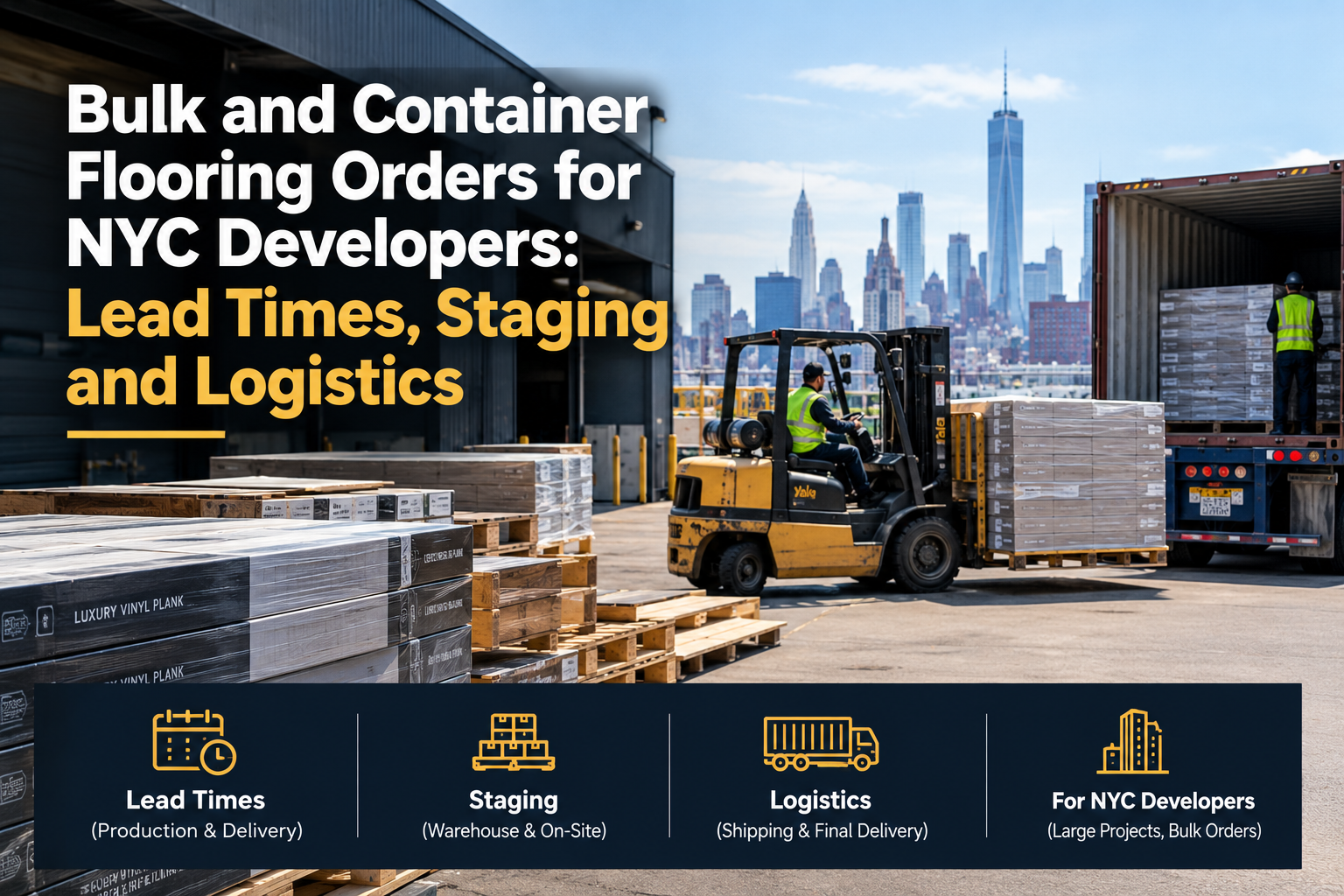
A standard 40-foot ocean container holds roughly 20 to 24 pallets of flooring (approximately 25,000 to 30,000 sq ft of SPC vinyl, or 18,000 to 22,000 sq ft of engineered hardwood). Total cargo weight exceeds 42,000 pounds.
The Job-Site Reality in NYC
You cannot drop a 40-foot shipping container on a congested street in Brooklyn or Queens without extensive NYC Department of Transportation (DOT) street closure permits. Even if permitted, leaving $100,000 worth of materials on a city sidewalk exposes cartons to theft, rain damage, and forklift accidents. Furthermore, stacking 40,000 pounds of flooring on a single floor plate of a partially framed building can exceed temporary structural load limits.
This is where our Brooklyn warehouse staging program protects developers. Woodcraft Flooring NY receives your ocean containers at our local yard at 309 Rutledge Street. We conduct incoming quality-control inspections, palletize the materials securely, and hold inventory in dry storage. We then dispatch staged, liftgate-equipped box trucks carrying 2 to 4 pallets at a time, matching the exact schedule of your installation crews floor-by-floor.
3. Lead Times and Milestones: How to Schedule Container Orders
Ocean freight and factory manufacturing require structured scheduling. Here is the realistic timeline developers must plan into their critical path:
| Project Phase | Typical Timeline | Action Required |
|---|---|---|
| Spec and Sample Sign-Off | Weeks 1 to 2 | Approve control samples, finalize total sq ft, sign trade agreement |
| Factory Production | Weeks 3 to 6 | Mill runs dedicated master batch; quality control lab tests wear layer and core |
| Ocean Freight and Port Transit | Weeks 7 to 10 | Vessel transit to Port of NY/NJ; customs clearance and drayage |
| Local Staging and Phased Drops | Weeks 11 to 16+ | Material arrives at 309 Rutledge St; released in scheduled job-site drops |
The Bottom Line: Maximizing Development Margins
For ground-up developments and multi-unit conversions in New York City, purchasing flooring in bulk container volumes represents one of the most effective strategies for reducing overall construction costs. By working directly with a factory-partnered distributor, developers secure institutional-grade pricing that significantly improves pro forma returns.
However, bulk purchasing without local warehousing creates immense operational risk. Partnering with a Brooklyn-based distributor provides the staging infrastructure required to inspect, store, and deliver material in structured phases. This keeps your job sites organized, prevents site damage, and guarantees that every apartment unit receives identical, single-lot quality.
Plan early, lock in single production runs, and leverage local warehouse staging to keep your developments on budget.
Frequently Asked Questions (Trade FAQs)
1. What is the minimum square footage required for a container order?
A standard 20-foot container holds approximately 12,000 to 15,000 square feet of engineered hardwood or 15,000 to 18,000 square feet of SPC vinyl. A 40-foot container accommodates 25,000 to 30,000+ square feet. For projects below full container thresholds, we consolidate bulk orders through our routine stocking containers.
2. Can developers mix different SKUs within a single container?
Yes. We frequently arrange mixed containers combining standard residential unit flooring (such as 20-mil SPC vinyl) with penthouse engineered hardwood or commercial amenity carpet tiles, provided they originate from the same factory partner.
3. How does warehouse staging pricing work for large developments?
For registered commercial development partners, we include 30 to 60 days of complimentary warehouse staging at our Brooklyn yard to absorb unexpected job-site delays. Extended staging terms are available at nominal pallet rates.
4. What happens if our project runs short on square footage?
We always calculate an appropriate contractor overage and attic stock buffer during the initial takeoff. In the event of unforeseen site changes, our local Brooklyn warehouse stocks compatible backup runs to prevent job shutdowns.
5. Can we view completed multifamily projects supplied by Woodcraft?
Yes. We regularly supply residential towers, condo developments, and commercial properties across Brooklyn, Manhattan, and Queens. Review our featured projects gallery or contact our trade desk for developer references.
Published by Manny and The Woodcraft Technical Team | Woodcraft Flooring NY, 309 Rutledge St, Brooklyn, NY 11211 | Last reviewed October 2026